
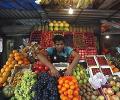
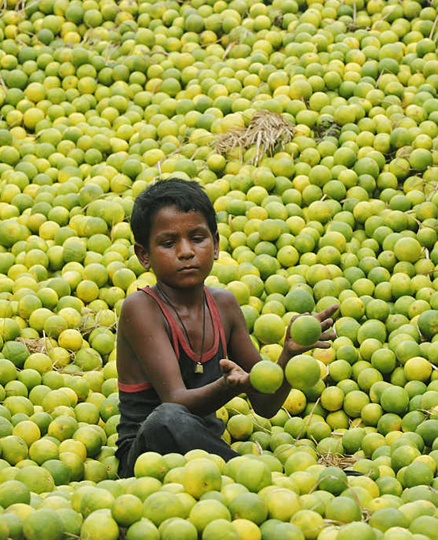
Costlier fruits and vegetables such as onions and tomatoes pushed retail inflation to a nine-month high of 11.24 per cent in November, making it harder for the Reserve Bank to lower interest rates.

The country's gross domestic product (GDP) growth is likely to be 8.8 to 9 per cent in the current financial year, driven by agriculture and industry sectors, Care Ratings said in a report. The country's economy had contracted by 7.3 per cent in fiscal 2020-21. The agency said the outlook for the Indian economy on almost all counts in FY22 would look seemingly better than FY21 on account of the negative base effect.

New Reserve Bank of India chief makes his first monetary policy statement on Friday with expectations he may scale back some of the emergency measures that have helped the rupee bounce from a record low.

RBI's status quo on rates disappoints economists.

CPI inflation is on the decline since July.

The country saw two straight years of deficient monsoons.
.jpg)
As on Monday, the prices of many vegetables had fallen as much as 50% compared with those a month before, due to increased supply, following the arrival of winter crops in the markets.
Some say the MPC will raise the rate, while others are of the view that there is already de facto interest rate tightening through rising bond yields, which might prompt the central bank to go for a pause.
According to the global financial services major, inflation may remain sticky, with a possible El Nino effect on the monsoon likely to push up food prices and geopolitical uncertainties seen pumping up global commodity rates.
Softening of global commodity prices might not help much
In October, CPI inflation was 5 per cent.

While commercial vehicle (CV) sales were the worst hit, down by 21 per cent to 67,793 units from 85,833 units, two-wheeler sales dropped by 16 per cent to 12,64,169 units from 15,00,545 units. Passenger car sales dropped nine per cent to 215,716 units from 236,586 units.

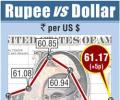
The rupee has posted its biggest single-day fall in more than four months to end at 62.95 against the dollar.

Inflation moderates, but a rate cut is unlikely.

The rupee bounced back by 26 paise to end at 59.93 against the American currency on Friday as exporters and some banks sold dollars.
Markets surged in late trades to snap five-day losing streak led by bank shares.

Bank Nifty closes at a 30-month high; Rate sensitives lead the rally on RBI rate cut optimism.

The Reserve Bank of India unexpectedly raised its policy interest rate on Tuesday by 25 basis points (bps) but said that if consumer price inflation eases as projected, it does not foresee further near-term tightening.

The Reserve Bank of India's latest data indicate that spending per card is rising steadily - something that consumers should worry about
Jaitley said inflation has been under control for long and is likely to remain so on the back of good monsoon and unlikely spike in oil prices.
Repo rate may well end 2013 at 8 per cent, where it had begun the year.

The WPI inflation stood at negative 2.4% in May 2015, compared with a negative 2.65% in April 2015.

Factory output in June likely rose 5.4 per cent from a year earlier, faster than the 4.7 per cent growth in May, according to a poll of 27 economists.
In New York, the dollar fell against the British pound on Wednesday after the Bank of England raised its projections for UK growth in 2014. However, analysts warned that gains against the dollar could be limited.

Disagreeing with Reserve Bank's projection on the price situation, former RBI Governor and PM's Economic Advisory Council chairman C Rangarajan said WPI and CPI may not be as high as being projected by the central bank.

The RBI cut the rate several times last year to reduce it by 125 basis points to the current 6.75 percent.

Despite admitting to price pressures both from food items and input prices, RBI Governor Shaktikanta Das on Wednesday hoped that a normal Southwest monsoon will have a "soothing impact" on inflation pressures and ruled out any wide variations in medium-term inflation forecast from what was given in April. In an unscheduled address earlier in the day amidst the raging pandemic, Das said the overall outlook for the economy is highly uncertain and is clouded with downside risks. He offered a slew of relief and liquidity measures to individuals and small businesses apart from a Rs 50,000 crore special liquidity window to the healthcare sector.
Data late on Wednesday showed consumer price inflation eased more than-expected to a 25-month low of 8.10 per cent in February, while industrial output unexpectedly expanded, albeit only by 0.1 per cent.

Managing Brexit, inflation and banking reforms, along with the political environment, will be tough.
.jpg)
The Indian rupee touched record low of 65.52/dollar on Thursday and is down 16 per cent so far this year despite efforts by policymakers to prop it up.

With inflation figures expected to be well within RBI's target, there may be room for further rate cut.
Also keenly watching inflation numbers, with wholesale inflation data expected today

The NSE Nifty, which again went past the 9,900-mark to touch a high of 9,903.95 intra-day, finally settled 103.15 points, or 1.05 per cent higher at 9,897.30.

Slight recovery in growth is expected only in July-September.

Gold discounts in India, the world's second-biggest consumer, widened this week as dealers struggled to offload stocks amid sluggish demand.

Distress sales, market closures and anchoring of fishing fleets have been reported from West Bengal, Andhra Pradesh, Tamil Nadu and Kerala.

The economic survey for 2020-21 has suggested revision in the weightage of food items to gauge the true picture of inflation in the country, and said new sources of price data also need to be incorporated in the wake of increasing retail e-commerce transactions. As per the survey, the current spike in consumer price-based retail inflation of food prices is mainly a supply-side phenomenon. The survey noted that the weights of all items in retail inflation are based on the NSO household consumption expenditure survey of 2011-12, adding the weight of food items in the index might have significantly decreased over the decade since then.

According to bankers and economists, there is room for further rate cut by the RBI as retail and wholesale inflation rates have remained benign.

Scores of employees took to social media to express disappointment and said they were asked to resign over WhatsApp calls. On Twitter, some said they had been asked to resign by May 31 and that there was no severance package and salary would be paid only for May.

The economists, who were surveyed, also felt it will take time for banks to make any further reduction in deposit rates
